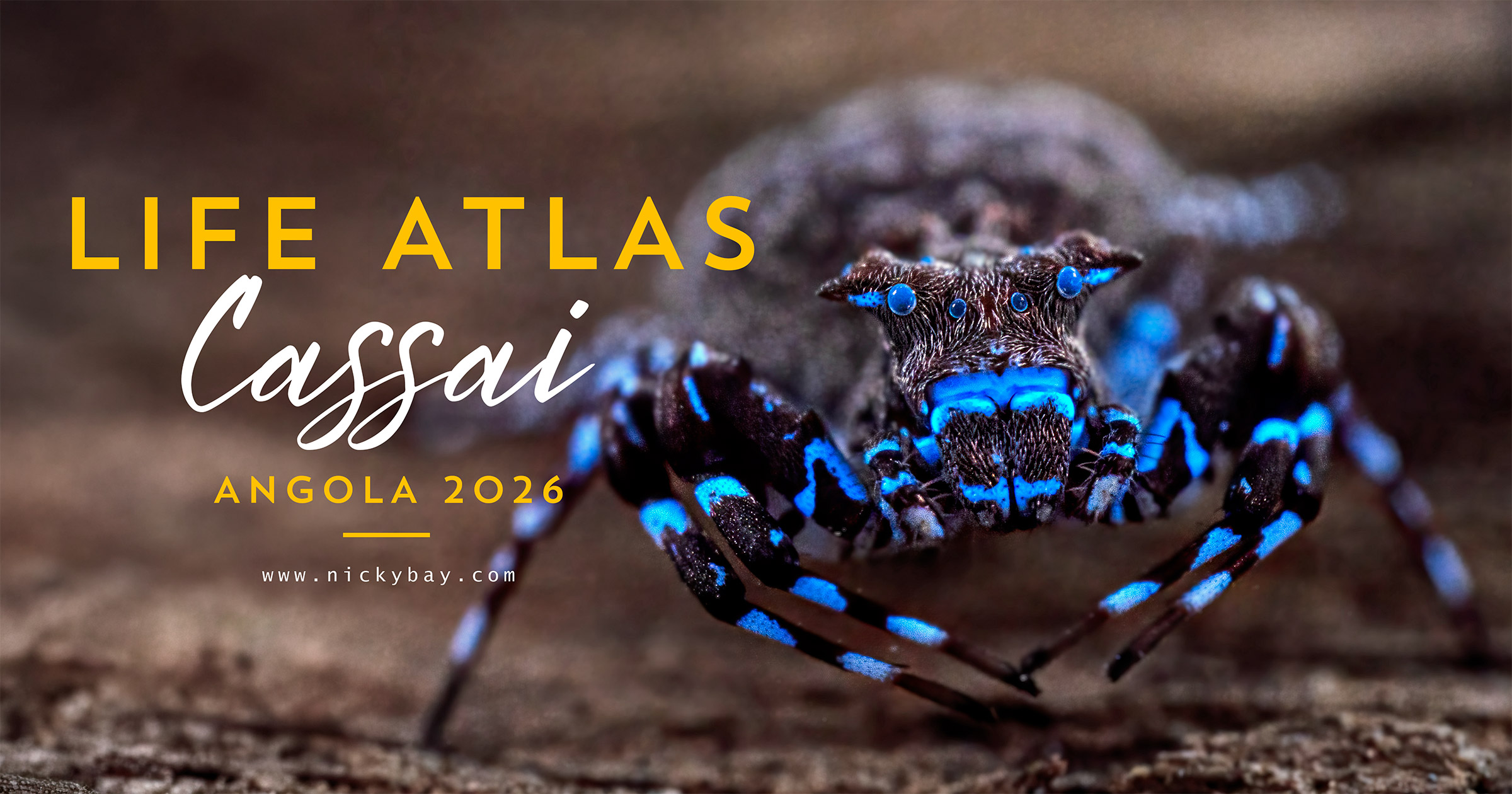
Cassai Life Atlas: Angola 2026
For three weeks in February 2026 I was in the highlands of Angola — the plateau that feeds the Okavango, Zambezi, Congo and Cuanza rivers — on a biodiversity survey called the Cassai Life Atlas. The team consisted of 8 local and 8 international volunteer specialists, including entomologists, botanists and a herpetologist, a documentation team of a videographer and macro photographer (me!), plus a mine clearance crew from HALO Trust, a group of local support staff, and the organisers from The Wilderness Project. Most of this plateau has never been surveyed, and not for lack of interest — it’s been sitting behind decades of landmines left over from Angola’s civil war. HALO’s team swept and marked safe corridors ahead of us each day so the rest of us could actually get to the field and start working.
Lisima refers to Lisima Lya Mwono (“The Source of Life”), the critical water tower and highlands region in Angola where major rivers like the Okavango and Zambezi originate.
My job was to document the microfauna, while the rest of the specialists were out setting traps and chasing after dragonflies, butterflies, orthopterans, frogs, snakes, spiders, beetles, bats and lots more. At the end of the survey, the specialists had a rough idea of the number of species new to science. The actual process of formally describing them may sometimes take years, which is normal for this kind of survey, but it’s a decent sign the plateau still has loads more for us to discover.
Here’s a video trailer that summarises the expedition:
Expedition Microjournal
This photo journal is sectioned by location, highlighting the finds and a peek into the operating conditions in the expedition. I took about 12,000 photos for this trip and uploaded about 3500 edited photos to Flickr, so what you see here is less than 2% of the photos that I shot. To check out my other photos, you may view my Angola Flickr Collection or my iNaturalist Observations.
Arrival in Luena
Most of the non-local specialists arrived in Luena via Luanda. Unfortunately, Werner’s luggage didn’t arrive with him and he had to go shopping for some necessities.
Nursery Web Spider (Perenethis sp.)
While waiting for our vehicles at the airport, we spotted some spiders scampering around in the grass patch. I initially thought that they were lycosids, but the egg sac’s position showed that it was more likely to be a pisaurid instead.
The only other hotel in Luena
The start of the expedition got delayed due to vehicle breakdowns, so instead of going into the field on the first day, we had to stay for another night in Luena. This seemed to be the only other hotel in town! Most of the convoy had travelled over several days from South Africa, so they had already gone through countless potholes along the way!
Stopping for breakfast
Had several stops along the way to our first campsite, and had our meals on the cruisers while exploring the area.
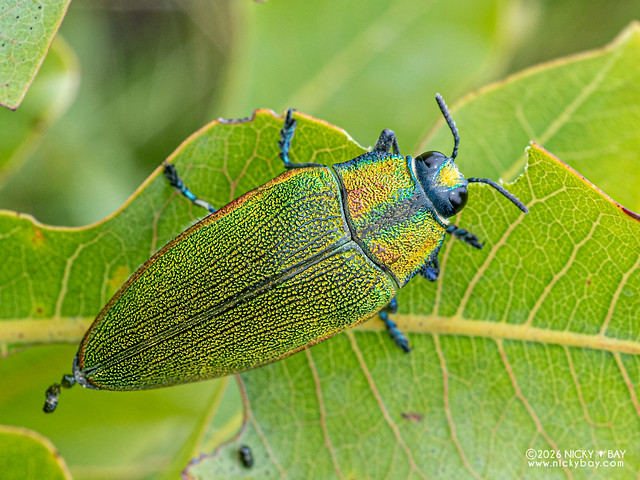
Jewel beetle (Lampetis muata)
At one of the stops, KD and Piotr pointed out a couple of jewel beetles.
Fixing the cruiser
Occasionally, we’d have vehicle breakdowns as we were going through some difficult terrain.
Darkling beetle (Sepidium sp.)
This fascinating tenebrionid turned up too, with a furry, overhanging pronotum and somewhat armoured elytra. Hermann commented that these were predatory darkling beetles.
Making plans for campsite
With the delays, we had to make plans for a temporary campsite and make sure that there was a clean water source nearby.
Leafhopper nymph (Cicadellidae)
Each time we stopped, the taxonomists hopped off immediately to explore around. This cryptic leafhopper nymph keeps its body flat and sometimes even aligned to the leaf veins.
Push-starting the Kamaz
Once, the Kamaz wouldn’t start and we had many of us trying to help with a push-start.
Lynx spider (Oxyopes cf. flavipalpis)
This lynx spider’s colours are sharply contrasted.
Chasing dragonflies
Rob, KD and Reinier (not in picture) would often be jumping into the wet areas with tall grass in search of odonates and butterflies.
Darkling beetle (Uloma sp.)
Looked like a plain beetle initially, but this darkling beetle has a centrally depressed pronotum and adorned with tiny little horn bumps.
Snug tent interior
Finally settled down at camp 1! It rained the entire night so we just took the opportunity to rest. It was supposed to be the rainy season, so the wet weather was expected.
Trapdoor spider (Idiopinae)
First mygalomorph of the expedition! The AME are so far apart from the PME — a typical trait of this family.
Breakfast
Breakfast was ready every morning at 6am. It was almost always oats, but we’d often get chocolate powder and milk powder as toppings — a luxury in the wilderness.
First camp briefing by Rob
With everyone in the camp in attendance, Rob began the camp briefing and introductions.
Reed Frog (Hyperolius parallelus)
This reed frog is common around our campsites, but the colours never get old.
Water filter pump
Our drinking water would be fetched from a stream nearby and passed through a manual filter. Sometimes, it worked. Sometimes, the water sprayed all over and it took really long to fill a bottle. This happened because there were just too many of us sharing the same filter.
Jewel beetle (Agrilus sp.)
Another tiny jewel beetle, easy to miss but worth a second look.
Dung beetle (Catharsius satyrus)
We would hear loud buzzing sounds in the morning when the dung beetles were in flight to catch the first shit of the day. Several of them were simply caught mid-flight.
Fetching water from here
There’s our water source at camp 1! Lots of sediment floating around so my laundry would appear to get dirtier after a wash (but smells nicer, so that’s a good trade off).
Hoverfly (Monoceromyia sp.)
KD spotted this wasp-mimicking hoverfly. One leg was broken so I just took a record shot from the other side.
Tunnel spider (Segestriidae)
This looked like a segestriid. Spiders from this family build silken tunnels under tree bark or between the cracks.
Horned babboon tarantula (Ceratogyrus cf. attonitifer)
Werner, our herpetologist, was peeling some tree bark in search of skinks and geckos, and came across a silken tunnel in the tree within a termite’s nest and inside it, a juvenile Ceratogyrus. This species looked close to C. attonitifer.
Waiting for dinner
We usually had our dinner in the dark as the sun sets by 6pm, as the chef hollers “GRUBS UP!” and the rest would respond with “COPY!”.
Horned baboon spider (Ceratogyrus cf. attonitifer)
Spiders of the genus Ceratogyrus are commonly called “Horned Baboon Spiders” for their unusual dorsal horns on their carapace. Most known horns are sclerotised and short, until a species with an exceptionally long dorsal horn stretching all the way back to the end of its abdomen, Ceratogyrus attonitifer, was discovered in Angola a few years ago.
I told myself that this would be my target species for the expedition. Who wouldn’t want to see a dickhead tarantula? 😂 But logistical hiccups along the way forced us to make changes to the route and miss the type locality of this exceptional species.
I really wanted to photographically show that the horn in this species was hollow, like a balloon. Turned out that it was not hollow, but filled with fat. If I ever see this species again, I’m going to touch that fat balloon on its head!
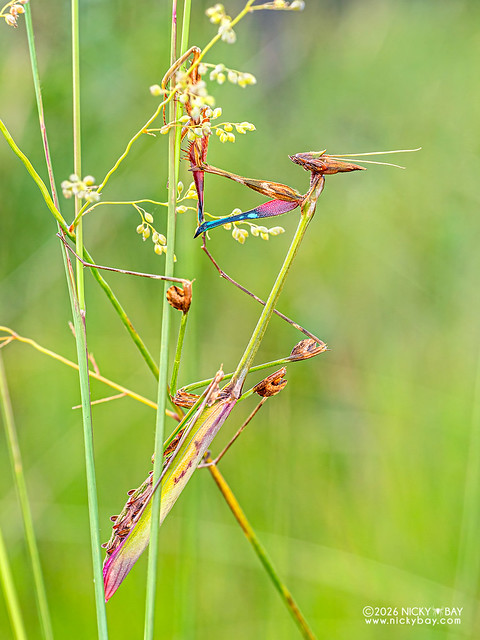
Gargoyle Mantis (Hemiempusa capensis)
The slender stick-like body of this Unicorn Mantis allows it to blend almost seamlessly among the tall grasses in front of our campsite. But when it starts to move, this one would flash vibrant blue and magenta on the inner forelegs.
Gargoyle Mantis (Hemiempusa capensis)
Just for fun, I wondered how this skinny little one would look with a big head…
Piotr’s workstation
In our research tents, the specialists would be processing their specimens. Sometimes, they would photograph the specimens or rear them to adulthood first.
Grass mantis (Pyrgomantis sp.)
Piotr showed me this grass mantis, doing an excellent job concealing its shape.
Solar panel to charge our batteries
Each day, we hoped for the sun so that our batteries could be charged. Sometimes, we had to keep shifting the solar panel to catch the sunrays!
Spiny flower mantis (Pseudocreobotra sp.)
The spiny flower mantis is a usual crowd favorite. We saw at least 3 individuals during this expedition.
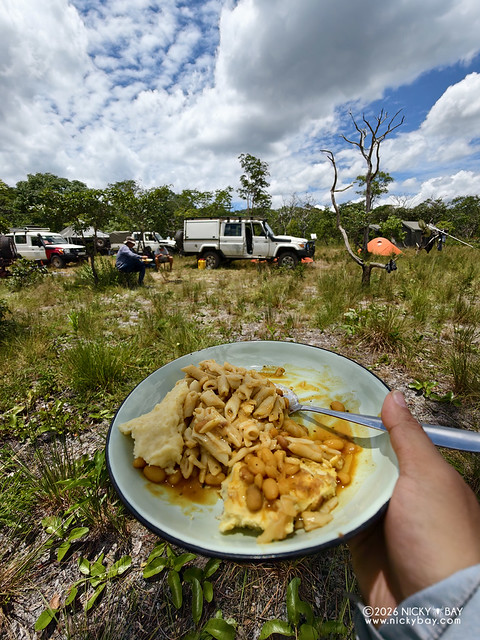
Packed lunch
On some days, we would venture further and spend the entire day outside. Lunch would be packed like this, and almost always some form of pasta.
Horn corncricket (Enyaliopsis sp.)
Reinier found the first specimen of this spiny cricket that is new to science. When threatened, it launches a surprising defensive tactic by squirting its own blood (hemolymph) into the attacker’s eyes!
Goliath fruit beetle (Mecynorhina confluens)
While dismantling our tents at the first makeshift campsite, Eric spotted a pair of these beetles high up in the tree. They eventually flew away before we could get to them, but Rob caught another (or the same one) later on. It was a solid find, so we had our beetle taxonomist Gimo posing with it.
Eduardo surveying the area for landmines
At each site, the HALO team would have to check the area for potential landmines and advise the areas that we had to avoid. This is usually done with their thermal imaging drones.
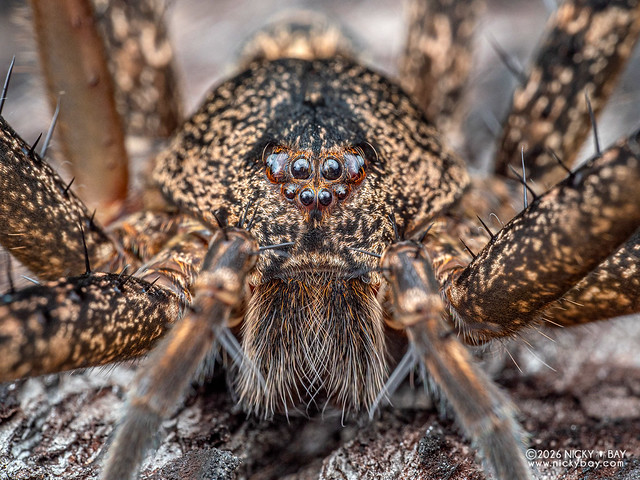
Flattie spider (Selenops sp.)
While most of the spiders that we saw were relatively small, the selenopids were several categories larger, and commonly sighted at our campsite.
Ladybird orb weaver (Isoxya kochi)
At first glance, most of us thought that this small tortoise-back orb weaver that Rob found was a Paraplectana or something in the same subfamily. But something seemed off. The carapace was definitely not that of Paraplectana — but we couldn’t quite place it. It was only after digging through old literature that I found a species originally described as Paraplectana, shuffled under 7 different genera over ~150 years, and eventually settled under Gasteracanthinae. Gasteracanthinae is named after its type genus Gasteracantha — meaning spiny (akantha) abdomen (gaster). And indeed, every known species in this subfamily has spines lining its opisthosoma (abdomen), except this one!
Orb weaver spider (Megaraneus cf. gabonensis)
Laurinda spotted this orb weaver from the rainforest. It looked close to Megaraneus gabonensis but the abdominal tubercles are rounded rather than pointed.
Tortoise beetle (Notosacantha sp.)
This tortoise beetle has a little notch that reveals its head.
Jewel beetle (Steraspis sp.)
While hunting around the bushes next to the river, we occasionally had large beetles flying loudly over our heads. Luckily, this one landed close by and I could give chase.
River crossing
Sometimes, we would be crossing rivers and Eric would be in the midst documenting everything!
Comb-footed spider (Chrysso sp.)
Next to the river, we came across this colourful Chrysso within the bushes.
Explorer, gateway to our slow internet
We had a patchy internet connection through this Explorer gateway. Only 1 or 2 of us could connect and send messages at any one time, or it would choke with more users onboard.
Lace bug (Ammianus junodi)
Mike was beating the bushes at the source lake when this beauty dropped. Lace bugs may look plain to the naked eye, but can reveal lots of intricate details in close-ups.
Ant-mimic katydid (Eurycorypha sp.)
This katydid nymph’s colours gives us the impression of an ant’s shape with the narrow “waist” connecting the abdomen to the thorax.
Spiky leaf beetle (Platypria sp.)
Rob turned up this brightly coloured spiky leaf beetle from the rainforest.
Chilling in the rainforest
We were taking a break here and having leftovers from our packed lunch for dinner.
African bush viper (Atheris squamigera)
About half an hour later, Eric spotted this bush viper at this exact spot where we were sitting on! (ex situ, the snake was picked up from the ground)
Spiny orb weaver (Gasteracantha milvoides)
This is probably a colour variation of Gasteracantha milvoides, which is commonly observed with alternating red and white bands.
Leftovers!
If we were at the campsite, lunch would usually be leftovers from last night’s dinner.
Monster tiger beetle (Manticora sp.)
Manticora is a genus of the world’s largest tiger beetles. They are ferocious and can bite and push through many materials, including some of the plastic vials that we used. That’s also how one escaped and ended up on Gimo’s neck in his tent.
Ghost mantis nymph (Phyllocrania paradoxa)
The leaf-like leg segments on this ghost mantis nymph work very well to keep it camouflaged.
Tree-stump orb weaver (Poltys sp.)
I’ve encountered thousands of spiders before and had never been bitten, until this Poltys. She was dropping from her web so I caught it with my hand. She didn’t seem too happy with that…
Setting up the UV trap
Our lepidopterists Reinier and Hermann had a custom umbrella tent with a UV tube inside to attract moths at night. Very interesting to see that the moths could find their way inside when the gaps were really small.
Broad-headed bark spider (Caerostris sp.)
Every night, I’d check on this Caerostris as it would build a huge web across the path that we’d take towards the swamp forest.
Emerald dung beetle (Kheper vanderkelleni)
In the mornings, we would hear loud buzzing sounds from the large dung beetles flying around. It is difficult to chase them to their landing location, so we’d usually catch them mid-flight and bring them down. The genus Kheper was named after the ancient Egyptian god Khepri (also spelt Kheper), who was represented as a scarab-headed god or a scarab beetle. This individual was photographed in front of our research tent on a sunny day.
Mirror spider (Thwaitesia sp.)
We came across this mirror spider (also known as the stained-glass spider) at the rainforest. The abdomen of Thwaitesia spiders is adorned with guanine crystals that appear expanded when the spider is at rest. When disturbed, these reflective patches seem to contract, revealing the brilliant red underneath.
Harvestman (Rhampsinitus sp.)
This harvestman looked plain at first sight, but its eye “turret” has several interesting spikes!
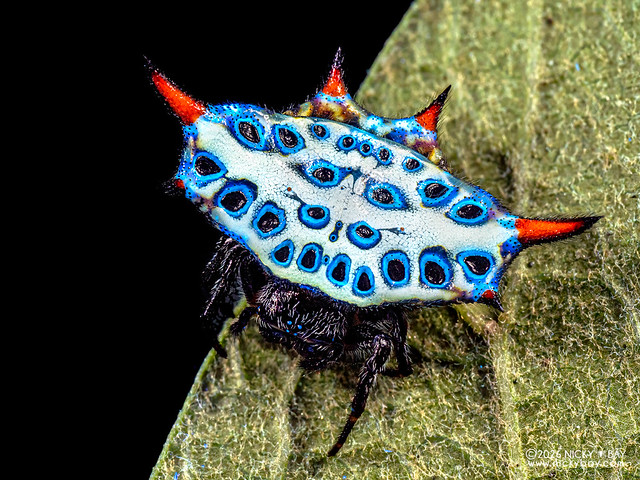
Spiny orb weaver (Gasteracantha sanguinolenta)
This Gasteracantha showcases its striking abdominal spines and distinctive muscular depressions. The rings around these depressions fluoresce brilliantly under UV light (see below).
Spiny orb weaver (Gasteracantha sanguinolenta)
Different specimen, but the UV fluorescence was exceptional!
Crowned crab spider (Smodicinus sp.)
Really surprised to see the crown on this Smodicinus as it looked just like a plain, inconspicuous tiny thomisid to the naked eye. Glad I bothered with some close-ups, and attempted this shot using modified twin ultraviolet flashes. In Malaysia, there’s Indosmodicinus, which has a more elaborate crown that looks like a tree growing on the crab spider’s head. Still trying to look for that one!
Crowned crab spider (Smodicinus sp.)
Dorsal view of the crowned crab spider under normal light.
Light trap
At every campsite, I would set up the light trap and top up the generator’s diesel every night. Now the problem is that the generator is NOISY and I had to put the trap FAR away from the campsite. Somehow, the trap got closer to the camp each time we moved sites and I have no idea why or how it happened. 🙈
Generator for our light trap
The generator and an additional diesel had to be lugged to the light trap during setup, and every night for additional fuel topups.
Mantisfly (Sagittalata sp. P2070874)
I didn’t manage to have the light trap up at camp 1 for the first night due to the rain. The mantisflies were there on every night though!
Many-plumed moth (Alucita sp.)
At most of the camp sites, we would see at least 1 or 2 many-plumed moths.
Cruiser stuck in river
On our way towards our planned second campsite, the cruiser got stuck in the water for a bit.
Setting up main tent
While the cruiser got itself unstuck eventually, the KAMAZ broke down a distance away, so we had no choice but to make camp here while we tried to get the replacement parts to repair our mothership. This time, we were much quicker to setup the main tent.
Stink bug nymph (Halyini)
This brightly coloured stink bug nymph turned up right in the middle of camp.
Campsite 2
Our own tents were quickly set up this time.
Fruit fly (Clinotaenia sp.)
It doesn’t look very obvious here, but the wing patterns on this fruit fly seem to be mimicking the legs of a spider!
Biltong, similar to beef jerky
We each had a bag of biltong to tide us through bouts of hunger. Not something that I’m really keen on, so I’ve been distributing them to others. Maybe I should trade them for more of the trail mix…
Wash your own dishes
After meals, we’d wash our own dishes here. The water doesn’t always look this clear.
Boomslang or not?
We may have little discussions in the research tent. We have Werner and Piotr here discussing about the ID of a snake (see below) while the rest of us watched on.
Large-eyed green tree snake (Rhamnophis aethiopissa)
Boomslang or not?
Two-lined Night Adder (Causus bilineatus)
Werner had this night adder out for some documentation and a few of us managed to steal some shots.
Congo Burrowing Asp (Atractaspis congica)
Very cooperative individual photographed next to the camp.
Barotse Water Snake (Crotaphopeltis barotseensis)
At the sandy banks of the river, this water snake was really angsty and attempted to strike us several times.
Dinner time
The main kitchen tent is typically engulfed in a cloud of smoke because there’s usually a campfire INSIDE the tent. It stings our eyes so we’d have to rush in to get our food quickly and run off!
Water source
This is the water source at camp 2. Felt much cleaner than the water from the previous camp site.
Emperor moth (Bunaeopsis sp.)
The light trap at camp 2 had a few more saturniids visiting us.
Ant nest beetle (Paussus sp.)
A few of these chonky-antennae beetles also turned up on the light trap.
Waiting for the guide
We stopped by at Alto Chicapa at the start of several field trips as we needed a guide from their village and sometimes had to “present ourselves” to the village authority (?).
Village kids
While we waited, the village kids would just stare at us.
Blister beetle (Hycleus sp.)
These blister beetles appear to be quite common and widespread.
Planthopper (Kamendaka sp.)
This derbid has intricate wing patterns.
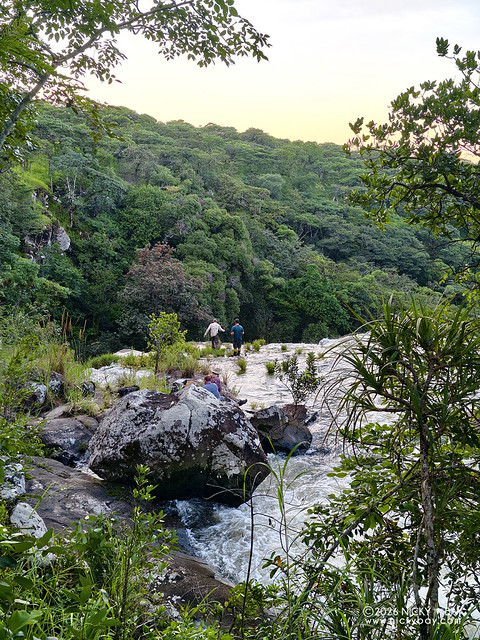
Big waterfall
We made a few trips to this big waterfall. I found that the invertebrate diversity was markedly higher than other sites.
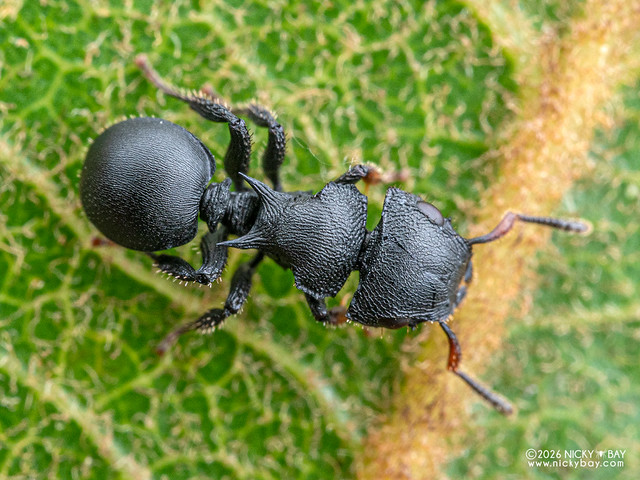
Armoured ant (Cataulacus sp.)
Happy to see these odd-shaped ants. I usually see them foraging on their own.
Leafhopper (Tettigoniella nigrinervis)
These leafhoppers were in abundance as well, but most were really skittish, jumping off before I could attempt any shots.
Katydid nymph (Plangia sp.)
This katydid nymph has an unusually short body.
Boxkite spider (Isoxya sp.)
I’d been trying hard to track down Isoxya spiders. Laurinda spotted a female while I turned up this little male.
Longhorn beetle (Zographus cingulatus)
Portrait of a large longhorn beetle.
Standing at the edge of the waterfall
The others climbed to the edge of the waterfall for stunning views, while I stayed put, choosing not to risk any of my equipment.
Waterfall from above © Eduardo
Eduardo kindly provided this photo of the waterfall from his drone. Quite a steep drop from the edge!
Ladybird beetle (Cheilomenes sulphurea)
This colourful ladybird beetle was hiding among the tall grasses.
Planthopper (Mesonitys taeniata)
Also within the same area, I managed some shots of this eurybrachid.
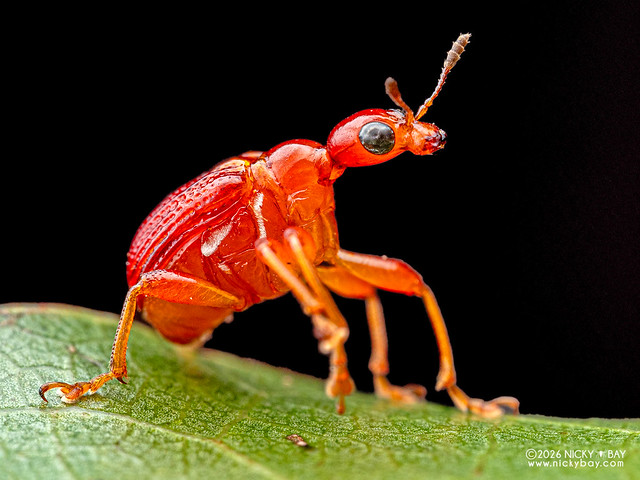
Leaf-rolling weevil (Apoderina)
This leaf-rolling weevil has a glossy, sculpted look.
Leaf-rolling weevil (Allapoderus cyaneovirens)
Another leaf-rolling weevil, this time in dusty blue.
Collecting an orchid
Botanist collecting orchid with help from the lepidopterist’s net and herpetologist’s hook while the macro photographer takes pictures with his mobile.
Lynx spider (Oxyopidae)
These cryptic lynx spiders turned up on the thin stems of bushes. They are super fast runners and are really tough to photograph.
Jumping spider (Salticinae)
Lots of jumping spiders that I’ve yet to identify…
Weevil (Holotrichapion sp.)
The rostrum on this weevil is noticeably elongated.
Small cave entrance
Did a bit of climbing to reach a small cave.
Planthopper (Lophopidae)
Plenty of these lophopids were scattered through the foliage.
Harvestman (Assamioidea)
Piotr, Rob, Mike and Telmo did a long, 16km hike to a supposedly large cave, and collected this harvestman among many others.
Recluse spider (Loxosceles sp.)
They also turned up a recluse spider near to the cave entrance.
Pirate spider (Mimetidae)
The pirate spider specialises in hunting other spiders.
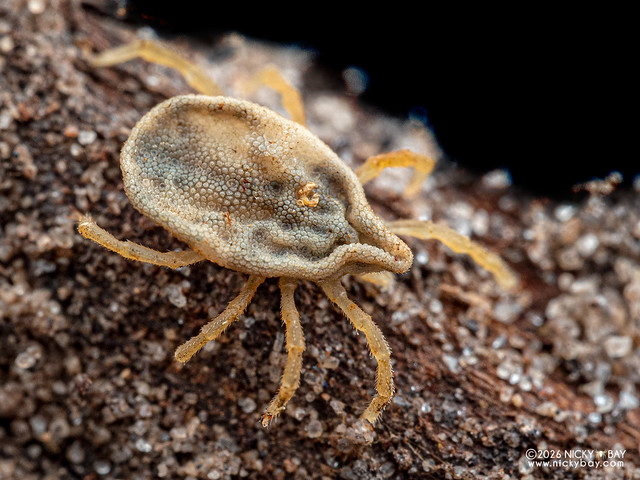
Softbacked tick (Ornithodorinae)
Leathery-bodied tick — can you spot its eyes?
Bat fly (Penicillidia sp.)
Piotr examined the bats in the cave and collected some of the parasitic bat flies. They are bizarre animals. Can’t see the head nor eyes!
Wind scorpion (Solpugema sp.)
Rob collected this wind scorpion, and excitedly pointed out how it glowed under UV.
Wind scorpion (Solpugema sp.)
Of course, I had to try!
View from higher ground
We hiked towards a smaller waterfall, but I skipped a steep hike and explored around the waterfall instead.
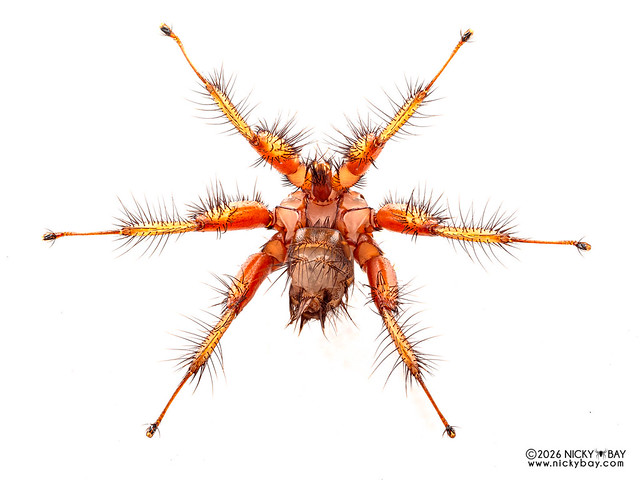
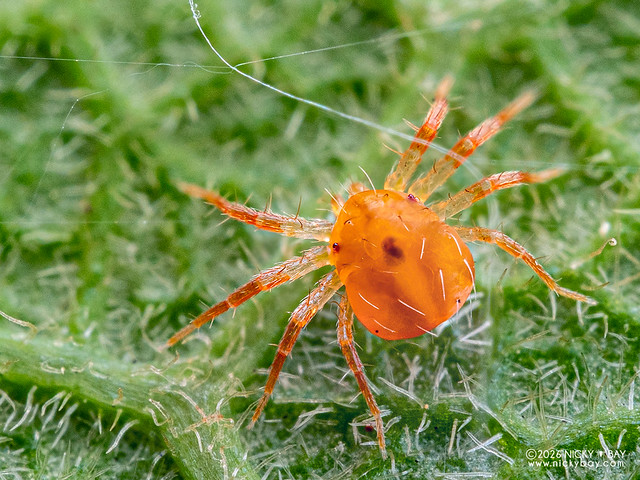
Whirligig Mite (Anystis sp.)
I was photographing something else when this tiny little mite scurried across.
Chalcidid wasp (Brachymeria sp.)
KD came across this wasp while out on his dragonfly hunts. Luckily, it stood still enough for a quick shoot.
Explorer 2, our next slow internet gateway!
Halfway through our expedition, the subscription for our first Explorer ran out and we are onto the second set.
Gaboon Viper (Bitis gabonica)
The village nearby left a dead Gaboon Viper for us. Its heart was still beating, but it was no longer showing any other signs of life.
Clearwing leopard moth (Eulophonotus hyalinipennis)
At the light trap, we saw this clearwing leopard moth from the family Cossidae.
Geometer moth (Geometridae)
We had too many moths, so I’ll just feature one occasionally.
Squathopper (Paropioxys sp.)
Spotted squathopper, heavy-set and audible when it hops off.
Flap-necked Chameleon (Chamaeleo dilepis)
Werner spotted this tiny little chameleon. Its colours changed completely after a few photographs, which could be a sign of stress.
Everyone vs stingless bees
In the later half of the expedition, we encountered relentless hordes of sweat bees. Even when taking a break, we had to cover ourselves up or they would be all over our faces.
Nicky vs stingless bees
Even with this and a fan blowing them away, many would still get behind my glasses.
Stink bug (Parantestia sp.)
There were a few stink bugs that looked plain to the naked eye, but revealed otherwise when viewed up close.
Boxkite spider (Isoxya cicatricosa)
I was delighted to find another Isoxya lifer, and even more excited to see how it looked under UV.
Boxkite spider (Isoxya cicatricosa)
Didn’t disappoint!
Lantern bug (Zanna turrita)
The team explored a patch of mossy forest and Rob collected this lantern bug.
Mossy forest
One of many views of the mossy forest.
Rose chafer beetle (Pachnoda leopoldiana)
A flower chafer beetle with striking red splotches over a yellow base.
Jewel beetle (Lampetis sp.)
Always a good day when a buprestid turns out to be new to me!
Weevil (Tanymecini)
When you only work on your arms in the gym… Wonder if they have any specialised use for the stout forelegs?
Spiky leaf beetle (Hispini)
One of the many spiky leaf beetles that we came across. Looks a little different…
Tent light
It was really difficult to locate our own tents at night when every tent looked identical. Luckily, I had these solar powered lights stabbed in front of my tent.
Crab spider (Firmicus bragantinus)
There were several crab spiders, but most were morphologically very similar.
Jumping spider (Festucula sp.)
This jumping spider with elongated legs and abdomen turns up within tall grass. Look closer and you’ll notice it’s exceptionally hairy as well.
Tree scorpion (Uroplectes occidentalis)
Laurinda spotted a pair of scorpions on a tree trunk.
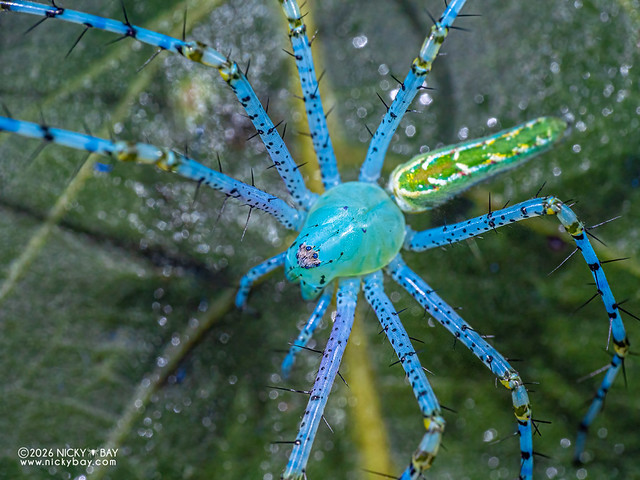
Green lynx spider (Peucetia sp.)
Before leaving for the next campsite, we revisited the mossy forest in hopes of more finds. Can you see the lynx spider?
Crab spider (Trichopagis sp.)
This crab spider had very unusual blade-like macrosetae at the corners of its eye region.
Village
We stopped next to this village to get directions to our next campsite.
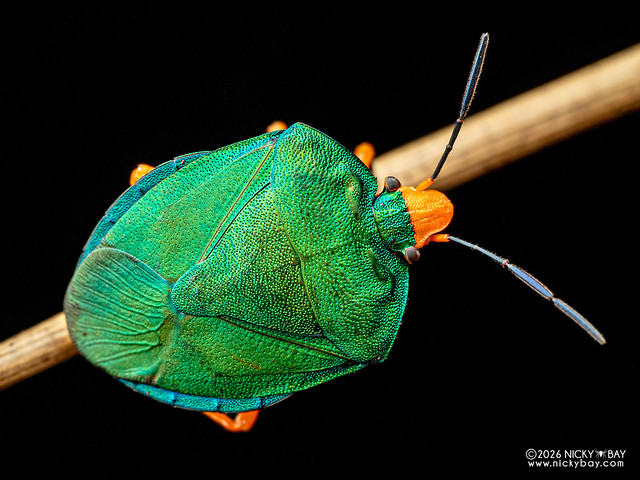
Stink bug (Caura bipartita)
This emerald stink bug turned up right in front of the village.
Caterpillar (Bunaeini)
This caterpillar also turned up at the sandy path in front of the village.
Research tent setup
At each new campsite, we would assist the expedition leaders to setup the main tent and research tents. Helps to get things moving faster.
Ladybird spider (Paraplectana sp.)
Fatigue was beginning to set in, but spirits shot up when Gimo, our beetle specialist, came across this Paraplectana while pitching his tent next to the stream. To him, it was meh. But exciting to me! I also tried exposing this girl to ultraviolet and it looked pretty neat!
Water source at campsite 3
This is the water source at camp 3. Looked questionable but clean and refreshing!
Pinhole borer beetle (Triozastus sp.)
This pinhole borer beetle has an abruptly truncated head and posterior. They excavate tunnels in dead or dying wood. With their posterior shaped like the entrance of the hole in the wood, it works like a plug to block out predators.
The Gimo Stretch
This is the Gimo Stretch that occurs several times a day. I never understood how he could angle his arms like this.
Lantern bug (Zanna sp.)
I did a lot of night walks at camp 3 as the area showed to be more promising, perhaps due to the proximity to the waterfall. Really glad to find another Zanna next to the campsite.
Emperor moth (Athletes gigas)
The first night at camp 3 saw lots of activity at the light trap, including several from the superfamily Bombycoidea.
Party in the troopie
Each ride in the troopie would be a boisterous affair at dangerously high decibels.
Hike to gully forest
We tried to hike down to a gully forest.
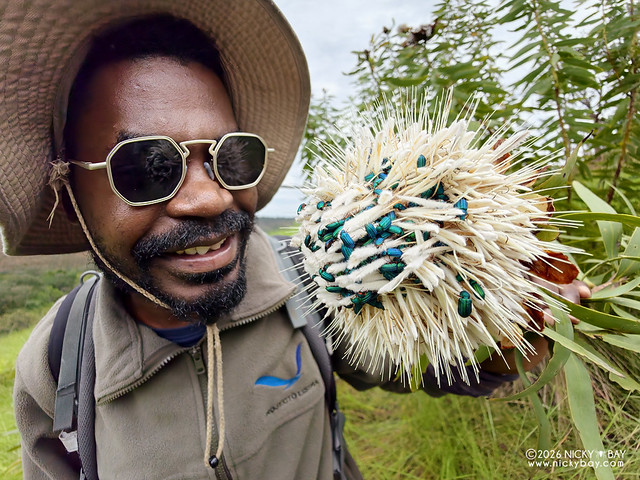
Telmo with beetle-infested flower
The Protea baumii robusta flowers were covered with Melyris groovewing flower beetles.
Groovewing flower beetle (Melyris sp.)
Closer look at the beetles.
Broad-headed bark spider (Caerostris sp.)
I was getting engrossed with photographing some of the subjects and found myself detached from the main group. Settled with exploring the area and trying to escape the sweat bees instead.
Protection against stingless bees
Some of us had more protection against the irritating swarm.
Mantis nymph (Amorphoscelidae)
This small mantis nymph turned up on the bark of a tree. The nymphs tend to sway their abdomen like little fish.
Assassin bug (Vitumnus sp.)
This assassin bug turned up next to the campsite.
Rove beetle (Zyras sp.)
This rove beetle visited the light trap late into the night.
Crab spider (Diaeini)
This crab spider refused to let go of her prey and had moth scales all over her after the struggle.
Cutworm moth (Mazuca amoena)
Just before calling it a night, this beautiful cutworm moth showed up.
Unknown
Rob spotted this unknown little speck that glowed brightly under ultraviolet.
Emperor moth (Lobobunaea sp.)
In the following morning, some of the moths were still around so I could take some wide angle shots.
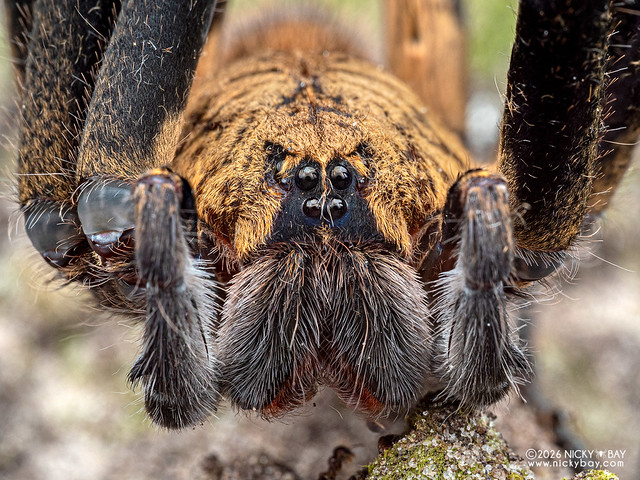
Wandering spider (Macroctenus kingsleyi)
A small team visited another cave nearby, and collected this very handsome wandering spider.
Tortoise beetle (Notosacantha junodi)
This tortoise beetle has mottled elytra with some thorn-like projections.
African Freshwater Crab (Potamonautes sp.)
Rob collected this freshwater crab from the river and got quite excited about it.
Orb weaver spider (Araneus sp.)
There were a few of these orb weavers round. The eye arrangement was superficially similar to that of eresids.
Planthopper (Mesonitys taeniata)
Another squathopper turned up nearby.
Gaboon Viper (Bitis gabonica)
In the evening, while Mike was trying to catch a cricket next to the camp, he chanced upon this Gaboon Viper resting in the grass and started screaming for Werner. The team hurried over excitedly, and I realised that I was still wearing flip-flops. Didn’t get too close to the viper and took more shots with my mobile instead.
Geometrid caterpillar (Chiasmia sp.)
Had a slow day, so I rummaged through Hermann’s caterpillar rearing boxes.
Big waterfall
As we approached the final days of the expedition, I hiked to the waterfall again, and was not disappointed (see below).
Treehopper nymph (Membracidae)
This membracid nymph turned up, with intricate detail across its body.
Spiky leaf beetle (Platypria sp.)
One more spiky leaf beetle for the collection.
Leaf-rolling weevil (Attelabidae)
A knobbly-looking leaf-rolling weevil turned up in the foliage.
Boxkite spider (Isoxya cf. mucronata)
Finally tracked down the female Isoxya on its orb web at a low height!
Boxkite spider (Isoxya cf. mucronata)
It lit up impressively under UV.
Bird dung crab spider (Phrynarachne rugosa)
I also came across a Phrynarachne specimen and explained to the team that nobody is capable of symmetrical poop.
Spiny flower mantis nymph (Pseudocreobotra sp.)
Stoked to find the purple morph of the spiny flower mantis!
Spiny flower mantis nymph (Pseudocreobotra sp.)
Even more stoked that it was feeding on the pesky sweat bees!
Campfire
Gathering around the campfire after dinner.
Jumping spider (Veissella sp.)
After dinner, we did a quick hike on the same trail again. Came across a Veissella guarding her eggs. It looks very similar to Brettus from Southeast Asia.
Orb weaver spider (Neoscona sp.)
I’ve been trying to get this orb weaver for several nights, as it had a golden orb web and dropped very quickly whenever we approached. This time, it ran to a corner and I managed to grab some record shots.
Fishing spider (Dolomedes sp.)
We had a flimsy log across the stream where we fetched our water from. At night, there was a large fishing spider hunting for prey.
Fishing spider (Dolomedes sp.)
A closer portrait of the same fishing spider.
Mirror spider (Thwaitesia sp.)
Another mirror spider turned up — a different species from the one we saw earlier.
Green lynx spider (Peucetia sp.)
While I was going to the research tent to charge my batteries, Rob spotted a Peucetia scampering around.
Green lynx spider (Peucetia sp.)
It exhibited a soft fluorescence under UV.
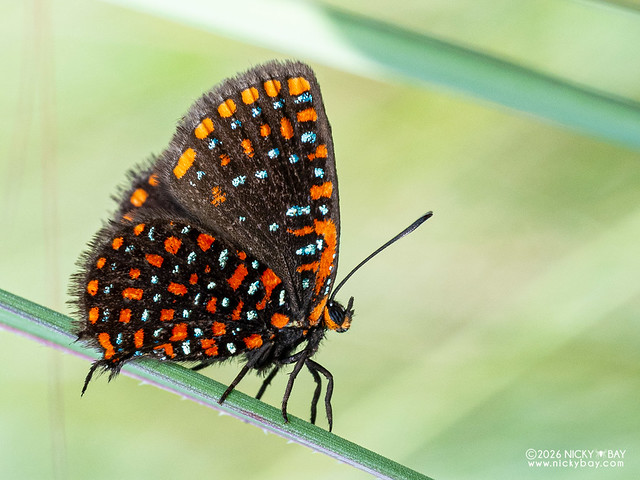
Checkered gem butterfly (Zeritis krystyna)
The next day, Reinier showed us this butterfly. I ended up using my mobile for this shot.
Interview with Reinier
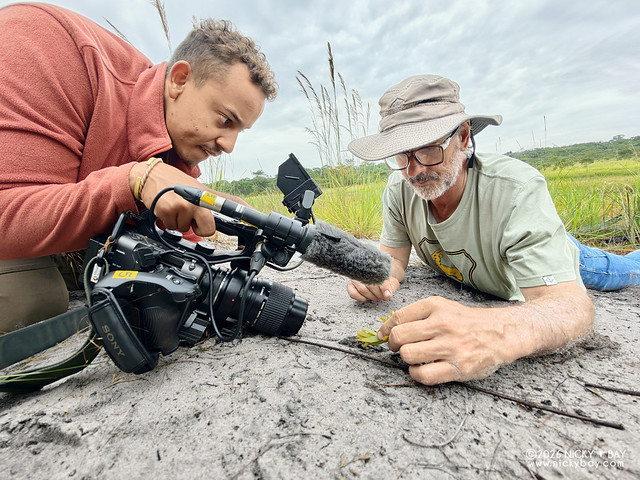
Throughout the expedition, Eric would be hijacking the specialists for an interview. Snippets of these interviews would then be used in a documentary and in the video at the top of this post.
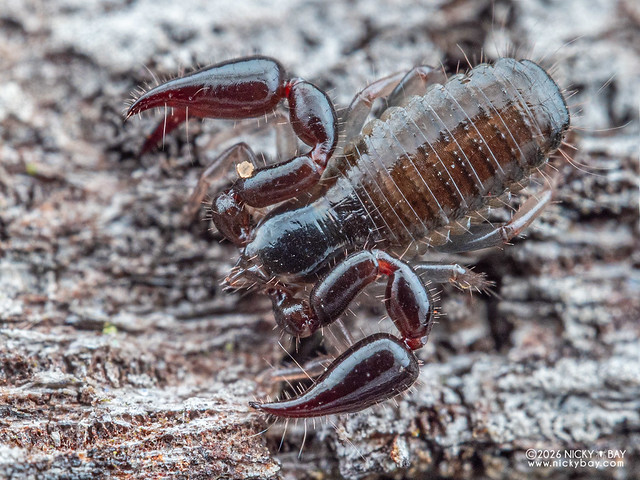
Pseudoscorpion (Pseudoscorpiones)
Laurinda had another pseudoscorpion from behind tree bark.
Filming predatory katydid with Piotr
We got Piotr to talk about an Enyaliopsis katydid that’s new to science.
Horn corncricket (Enyaliopsis sp.)
Wide-angle view of the Enyaliopsis.
Owlfly (Tmesibasis sp.)
I was keeping the light trap before we depart from camp 3, and found that some of the owlflies were still around, next to the light trap.
Preparing for group photo with drone
Not easy gathering the group for a photo. Everyone would get distracted all the time.
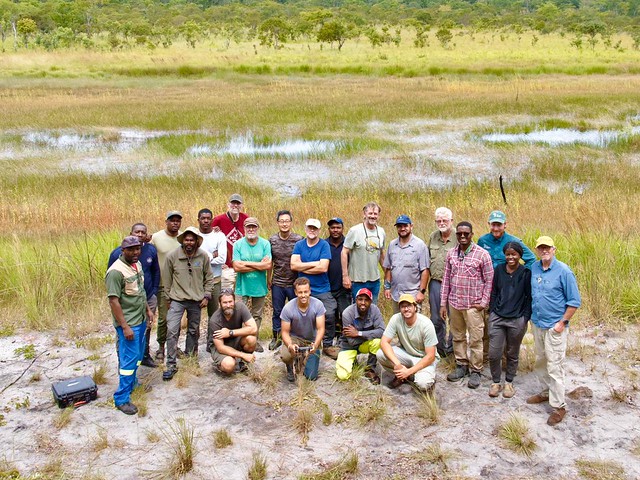
Expedition group photo © Eric Averdung
Thanks to Eric for getting this shot!
Campsite 4
Camp 4 is the final brief stop before we return to Luena. We made camp next to the river.
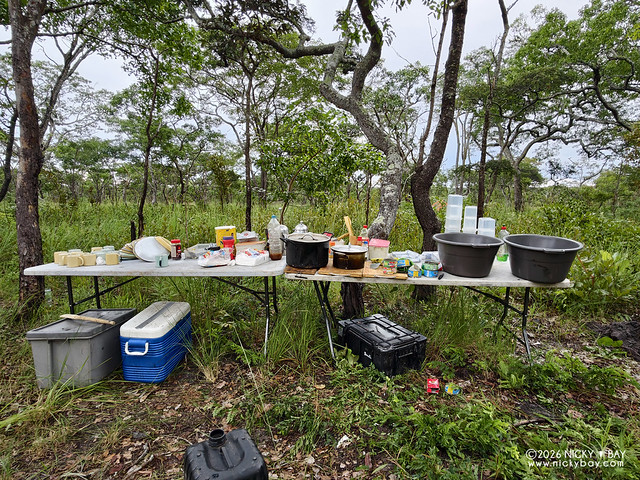
Makeshift dinner table
As it was only for one night, we didn’t set up the main tent and had our dinner prepared in the open.
Bull cricket burrow
The sandy riverbank was littered with burrows. I had my hopes up a little to find the horned baboon spider, but they all belonged to burrowing bull crickets.
Assassin bug nymph (Harpactorini)
Red-spotted assassin bug nymph.
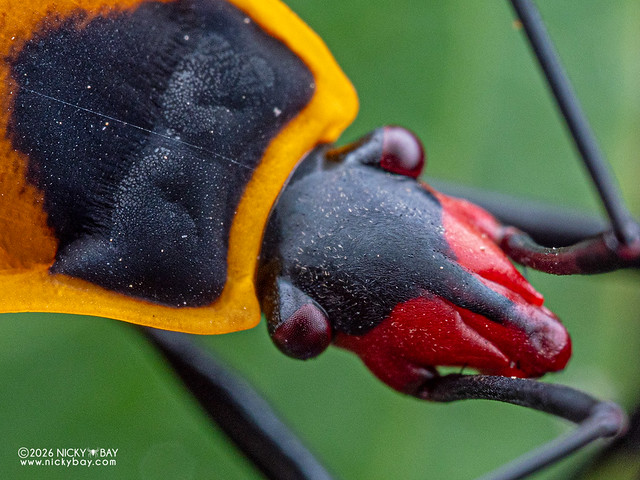
Red bug (Roscius sp.)
This red bug actually turned out more striking up close than expected.
Earth-boring beetle (Bolbaffer tenuelimbatus)
Rob turned up this super cute earth-boring beetle on the sandy river bank.
Clearwing leopard moth (Eulophonotus hyalinipennis)
Another clearwing moth showed up on the light trap the next morning.
Longhorn beetle (Macropsebium cotterilli)
Rob spotted this interesting longhorn beetle with reduced elytra.
Wasp-mimicking fly (Pyrgotidae)
We also had this wasp-mimicking fly on the trap.
Reinier showing the ants tending to a caterpillar
Reinier showed us this Erikssonia caterpillar that had ants tending to it.
Caterpillar (Erikssonia sp.)
Up close on the symbiotic relationship.
Campsite activities
While most of us were chilling, Eric had to document everything.
Pseudoscorpion (Pseudoscorpiones)
Another pseudoscorpion turned up!
Bark-gnawing beetle (Trogossitidae)
Gimo caught this very uncooperative beetle. It couldn’t stop running!
Ground beetle (Catascopus sp.)
This metallic ground beetle turned up on a tree trunk.
Darkling beetle (Cryphaeus sp.)
Before we left, Gimo showed me a few more beetles!
Longhorn beetle (Macropsebium cotterilli)
Always game for another portrait.
Camp debrief
Before our final leg back to civilisation, Rob gathered everyone for a quick debrief and words of appreciation to all involved.
Lunch break
We made just one stop for lunch on our way back to Luena.
Wolf spider (Lycosidae)
A burrowing wolf spider turned up on the sandy ground.
Wolf spider (Lycosidae)
Of course, a portrait is mandatory.
Angolan kids with weird Asian
While we were hanging around, the Angolan kids would surround us and stare. When I approached them for photos, they ran off. Took a bit of coaxing before they stood still for this.
The Expedition Team
None of this happens without the people who did the actual work: the specialists who could identify half of what we found on sight, HALO Trust’s demining crew who cleared the way for every field day, our local support crew who kept us fed and our vehicles running, the land support team who got us from site to site, and TWP for holding the whole thing together. Thanks also to TWP’s sponsors, who backed a survey with no guarantee of what the expedition would find.
Fingernails after 3 weeks
My fingernails after a few rounds of washing.
BugShot Borneo 2027
The next macro photography workshop will be BugShot Borneo 2027 along with Piotr Naskrecki, Thomas Shahan and John Abbott. Find out more and register here: https://www.bugshot.net/bugshot-borneo.
For those looking to extend their stay in Borneo, Kendra will be organising a pretrip to see other larger animals (details to be confirmed) and I will arrange an optional 4-night extension after BugShot to the entomology camp at Trusmadi (see Moths of Borneo: Gunung Trusmadi). Contact me at [email protected] for details.
Precamp – Road to first campsite


Camp 1 – Rainy Nights










Camp 2 – The Unplanned Site












Camp 3 – Waterfall












Camp 4 – Final Stop







Postcamp





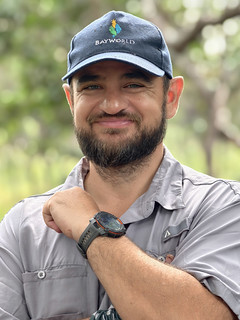


Dylan, Pascoal, Domingos, Eddy, Augusto

What’s Next?
This isn’t TWP’s first expedition to this plateau, but three weeks in, we were still discovering new species and much more remains unexplored. TWP isn’t finished here, and neither am I. From October to November, I’ll be out in the bushes again, this time in Kenya’s Mau Forest highlands. See you in the next journal!
Workshop